Designing Order Success at Weedmaps
On Weedmaps, adding the first item to a cart committed a shopper to a retailer. It was easy to read that action as a decision about where to buy. But someone could be interested in a product and still be comparing prices, checking delivery, or looking for a second item. The software had decided something the shopper was still working out.
I took over as lead designer for Order Success on the Marketplace team in late 2024. Weedmaps connected people shopping for cannabis with retailers, each with its own inventory, order minimums, fulfillment options, and payment methods. My work often came down to timing. When did someone have enough information to choose a store? When did we actually need them to create an account? And which of their choices could we carry forward if the order they wanted was no longer possible?
Rebuilding checkout on iOS to reduce abandonment
On iOS, shoppers encountered an account requirement when adding a product. Someone adding a product had expressed enough interest to build a cart. Asking them to create an account at that moment made even comparison shopping depend on signing up.
During the React Native rebuild, I led the cart and checkout design from discovery through development. I moved account creation to the point when the shopper tapped Checkout and brought the retailer’s order minimum forward into the cart, where someone could still change what they were buying. Payment required a different compromise. I advocated for removing the ambiguous “Cashless” option. The business retained it to support retailer-managed payments, so I explained how each method would work and preselected it when the retailer offered only one.
Cart · Minimum-order progress

Checkout · Account setup
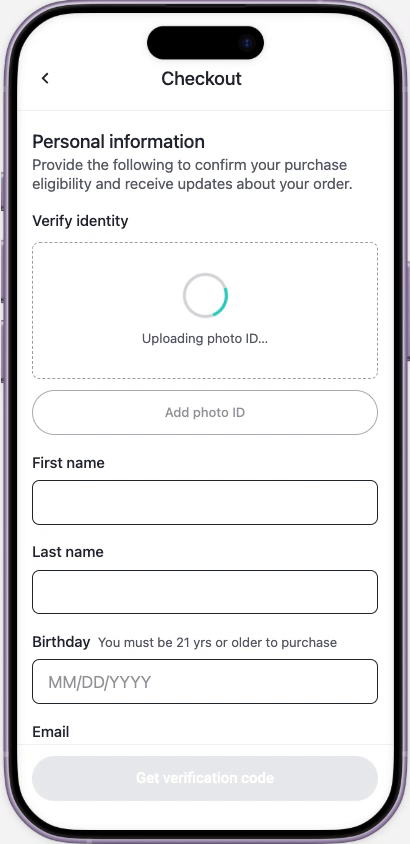
Follow a new shopper from cart to confirmation in the prototype, including the identity and payment requirements the release had to preserve.
The migration and redesign shipped together. Across equivalent periods before and after launch, iOS checkout abandonment fell from 28% to 19%, and median checkout time for completed orders fell from 30 seconds to 15. Payment-related customer reports fell from roughly 200 to 120 across comparable four-week periods.
From optimization to a new product bet
The cart brief raised a different question about people who kept shopping. In a Sprig survey, 42% of respondents with an item in their cart said they planned to buy outside Weedmaps. Someone could have a real intention to buy while still deciding which retailer deserved the order.
I proposed Magic Bag, a way to choose products first and then see which retailers could fulfill the bag. I compared it with two alternatives. Constrained Cart kept the existing retailer-first model and made the consequences of switching clearer. My Bags let shoppers keep a separate cart at each store. The choice between them turned on what the shopper most wanted to keep: a particular set of products, a relationship with a store, or several options while they compared. Improvements within the existing model yielded 40% fewer deliverability errors. Magic Bag gave us a product direction to test.
Magic Bag · Proposed concept
Build the bag

Match the order

Compare three cart models and see how each handles the moment a shopper wants something from another retailer.
Making repeat purchase resilient to changing inventory
On the next visit, a shopper had already told us something valuable through their purchase history. Yet on the web, one unavailable item could cause “Buy again” to fail for an entire order. Adding the button in more places would give people more ways to reach the same dead end.
I redesigned repeat purchase around individual products. A receipt could stay an accurate record of what someone bought, while a separate shopping action let them add what was available today. On a retailer’s menu, that meant showing even one familiar item still in stock. On the homepage, someone could start with a familiar product and then explore where to buy it. Among shoppers who engaged with repeat-purchase surfaces, conversion rose from 18% to 22%.
Order History · Mobile Web

Order History · Product-level recovery

Trace what happened when “Buy again” failed and how a product-level approach changed the role of order history, menus, cart, and homepage.
Defining the consumer behind the marketplace
In 2025, I led research into an existing model of five consumer segments. The original qualitative research described people’s motivations and confidence around cannabis. Product, Marketing, and Lifecycle wanted to use those descriptions to make decisions. I started by asking the teams what decisions they needed to make, then worked with Data Science and partners to understand which distinctions we could observe in shopping behavior.
One example changed our research plan. We could tell when someone was new to Weedmaps. That told us very little about their familiarity with cannabis or whether curiosity had brought them there. An experienced shopper creates a first account, too. Behavioral evidence supported three of the five segments. We documented where teams could use the model and where they needed more research, and held off on treating new users as a curiosity-based audience.
Reflection
What I took from this work is a question I still ask when reviewing a flow: What has this person already decided, and what are we asking them to decide next? On Weedmaps, the answer sometimes meant moving a requirement by one step. Sometimes it meant questioning why choosing a product had committed someone to a store at all.